


Questions and Answers About the V-16 Beacon: Spain’s DGT Clarifies Doubts and Debunks Rumors
With one month to go before the new emergency signaling regulation takes effect, the Directorate-General for Traffic (DGT) has released an official statement addressing the most common questions about the V-16 light beacon, the device that will permanently replace warning triangles as of January 1, 2026.
The DGT’s director, Pere Navarro, emphasizes that the connected V-16 represents “a significant step forward”:
“Warning triangles have served their purpose for 26 years, but now technology allows us to improve. Our aim is to reduce pedestrian accidents and increase protection for those forced to stop on the road.”
The DGT has also denied two widespread rumors: that the V-16 is less visible than triangles and that it poses a risk to users’ privacy.
???? Which vehicles must carry the V-16 beacon?
According to the General Vehicle Regulations, it must be carried by:
-
Passenger cars
-
Vans
-
Buses
-
Mixed-use vehicles
-
Trucks
-
Non-special vehicle combinations
For motorcycles it is not mandatory, although it is recommended.
???? How does the new beacon work?
The connected V-16 is an autonomous device that includes:
-
An integrated SIM card at no cost to the driver
-
Internal GPS
-
Guaranteed connectivity for 12 years
-
Operation that does not require a mobile phone or apps
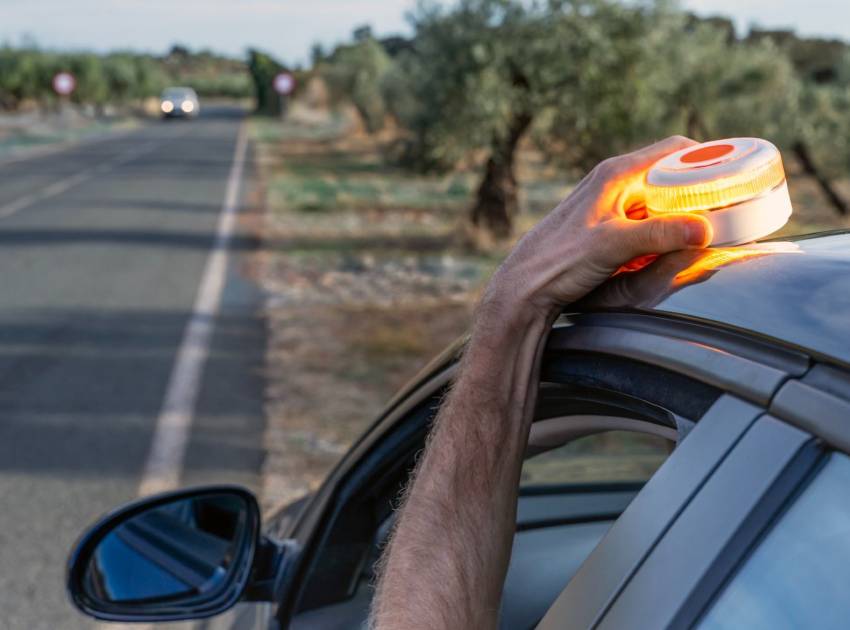
It should be kept in an easily accessible place inside the vehicle and placed from the driver’s seat on the highest possible point of the car.
Once activated, it:
-
Emits a light signal visible from one kilometer away
-
Sends the vehicle’s location to DGT 3.0, alerting other drivers through navigation systems and roadside panels
???? What should the occupants do?
After placing the beacon:
-
Exit the vehicle only if there is a safe area
-
Get out on the side away from traffic
-
If safety cannot be guaranteed, stay inside with the seatbelt fastened
???? Which model should I buy?
The DGT stresses that only approved beacons are valid—those listed in its official registry and marked with:
-
The name of the testing laboratory
-
The certification number engraved on the casing
Using a non-approved device may result in a fine.
???? The 10 most common rumors, clarified by the DGT
-
It won’t be mandatory. False: it will be the only valid system as of January 1, 2026.
-
It tracks your location all the time. False: it only sends your location when activated.
-
Any connected V-16 is acceptable. False: only approved models.
-
It requires a mobile phone or app. False: it works independently.
-
You will have to pay for the connection. False: connectivity is included for 12 years.
-
It doesn’t work in tunnels or areas without coverage. False: it uses high-penetration IoT networks.
-
It calls 112 or roadside assistance. False: it only signals and sends the position.
-
Triangles are safer. False: they require you to walk on the roadway.
-
Abroad, only triangles are valid. False: it is accepted in countries that follow the Vienna Convention.
-
The fine can reach €30,000. False: it is a minor infraction, €80.
???? Summary
-
The connected V-16 beacon will be mandatory starting January 1, 2026.
-
It replaces warning triangles and improves safety by preventing drivers from walking on the road.
-
It works without a mobile phone or subscriptions and is visible from 1 km away.
-
The DGT has addressed the main questions and debunked the 10 most widespread rumors.